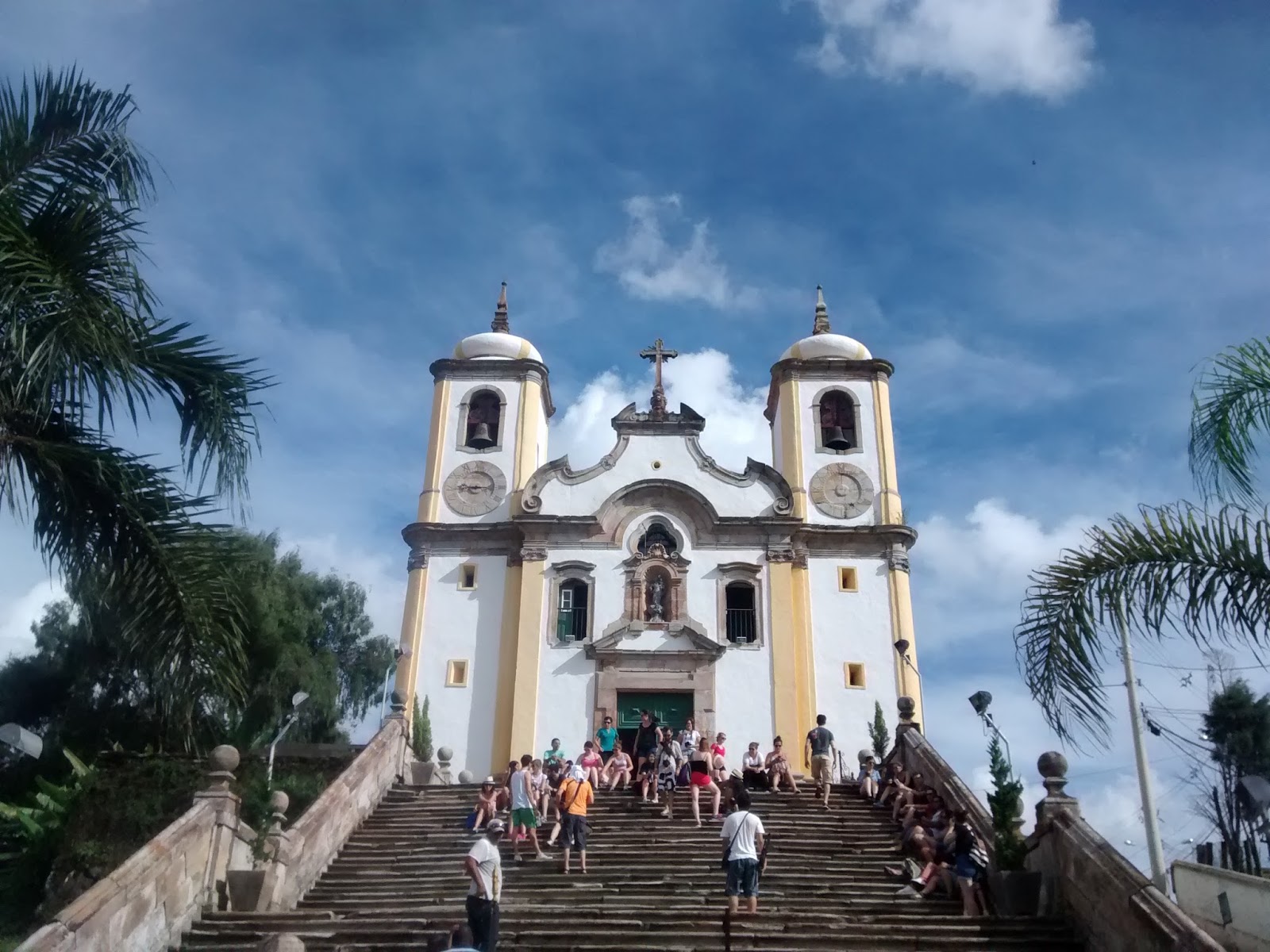
OURO PRETO
History
No place can be a better symbol of the Brazillian colonial past than Ouro Preto, which means "Black Gold". When gold was found in this part of Brazil, by the end of the XVII century and beggining of the XVIII, a gold rush started to the province of Minas Gerais (General Mines), attracting ambitious people to a colony where once the main economic activity was the sugar cane plantation and the extrativism.
The city flourished as one of the most important within the portuguese colonies, moving the economic centre of Brazil to the southwest region, and making the port of Rio de Janeiro the most important at the time, as it provided the best route to the shores. Later, the capital of the colony would be transferred from Salvador of Bahia to Rio, as the gold was transported from Minas to Rio.
Barroque Art in Ouro Preto
The gold rush provided enough resources for one the most impressive collections of Barroque Art in Brazil, since many churches where built in this style, with heavy wood doors and furniture and adorning altars covered with gold. The most famous sculptor, known as Aleijadinho, made hundreds of religious sculptures in a very peculiar and personal interpretation of the barroque.
Aleijadinho was the nickname of Antônio Francisco Lisboa, a nickname that in portuguese means something like small handicapped; in fact, his physical difficulties made his art even more impressive.
This lead Ouro Preto to be the first Brazillian site to be considered a World Heritage Site by UNESCO.
Aleijadinho´s sculptures can be found on nearby cities, speacially in Congonhas, where it is located his masterpiece, the sculptures of the profhets. There, in the churchyard of the Sanctuary of Bom Jesus de Matosinhos, Aleijadinho used soapstone to carve famous images of the twelve prophets. They have human dimensions and are visited annually by thousands of tourists.
Inconfidência Mineira - The Minas disloyalty
The amount of gold taken from the region and the tributes imposed by the Portuguese Crown made a more illustrated local elite start to question the Portuguese rule over Brazil. A movement lead by Joaquim José da Silva Xavier, called Tiradentes (the "teethtaker"), a local dentist, was the first attempt to declare the Brazil´s independence. The plot was named Inconfidência Mineira (the Minas disloyalty) as some people wanted to organise a revollution against Portugal. The plot was discovered and the punishment applied by the Crown was an example to all traitors, and Tiradentes was quartered in the public square.
The main building in Ouro Preto´s Central Square now hosts the Museum of Inconfidência. Besides the history of Inconfidência, it shows in a very interisting way how people lived there at that time, for example, which clothes they used, social positions, food and transportation. The museum also hosts many barroque sculptures and utensils from that time.
Getting there
Ouro Preto is about two-hours drive from Belo Horizonte, the capital of the State of Minas Gerais. If you rent a car at the international airport in Confins (CNF), you´ll have to cross an outer highway around Belo Horizonte (also known in Brazil as BH). After that, a small road among the mountains leads you to Ouro Preto. Depending on traffic jams at Belo Horizonte , the trip can take more time.
Of course, tour operators offer the same ride. Knowing nearby cities is also a good trip, as they form an ensemble of historic cities from the times of the gold and diamond rush, during colonial period of Brazillian history.
Thursday, August 13, 2015
Sunday, August 9, 2015
LENÇÓIS MARANHENSES
The Place
In the north of Brazil, beetween the Amazonian states and the northeast states, lays the state of Maranhão. It separates the biggest rainforest in the world, the Amazônia, from the semi-arid areas in the countryside of the northeast states, the caatinga. And, in the shores of Maranhão, there´s a very unique formation of dunes and lagoons, known by the name of Lençóis Maranhenses.
This set of white and smooth dunes, seen from afar, seens sheets ("lençóis", in portuguese) lying over a bed.
In this case, a very big bed, which takes many square kilometers from the ocean to the borders of the Preguiças river, which is inside the Lençóis Marenhenses National Park.
Photos can´t make justice for the beauty of the place, and by only beeing there one can realize the high the dunes can get. Better prepare your legs, it won´t be an easy ride.
During and some time after the rainy season, lagoons are formed inside the dunes, producing a very different set of natural swimming pools.
Saturday, August 8, 2015
GRAMADO AND CANELA
In the southernmost state of Brazil, Rio Grande do Sul, a pair of two cities puts you in an unimaginated european atmosphere in South America: Gramado and Canela.
(above, Rapunzel´s Tower in front of the Black Lake and inside Gramado´s church)
This region, settled by german inmigrants mostly, is know for very good cheese, wine and fondue, as well for its german-style cooking.
The most famous winery in Brazil is Miolo (www.miolo.com.br), located in the area of Bento Gonçalves, another city in the Serra Gaúcha. For visiting, you can see the tips at http://www.miolo.com.br/en/enotourism/
Both Gramado and Canela are very close to each other (7km) and no more than two hours drive from Porto Alegre, the state capital. There are tour operators to get you there, but renting a car at Salgado Filho International Airport is a very convenient way to go there. Don´t forget taking the GPS. Also, the car will allow you to know neighbouring cities and wineyards, making the trip a lot more interesting.
The cities are located in a mountain range known as Serra Gaúcha, one of the coldest parts of Brazil, though, even in winter, it is rare temperatures can get under 0 degrees Celsium.
During Christmas, Gramado celebrates the "Natal Luz", or "Christmas of Light", with Santa Claus´parades, fireworks and celebrations. It´s a hot Christmas, since it is winter in South Hemisphere, but very recommended for families with children.
(above, streets of Gramado and one of its Chocolate stores, during winter)
Gramado also helds the Brazillian Film Festival, held in august. Their site is only in portuguese and spanihs: http://www.festivaldegramado.net/novo/. It is a good time to visit the city, as there are music concerts and parties, and it is also held the kikito award to the best movies. The kikito is a parody of the Oscar, a funny way to celebrate brazillian cinema. Here it is the main road of the city:
Canela has a very beautifull stone Cathedral, which is worth visiting:
And, as we´re in Brazil, there´s always something related to the nature to see. The Caracol Cascade is at a natural park nearby Canela, and can be seen from the top very easily. Going down requires effort and physical preparation, so it isn´t advisable for people with reduced mobility. The visit can also be done by a cable car (2nd photo down).
Gramado also hosts, in the middle of the city, the Lago Negro (Black Lake), surrounded by poplars and cypresses.
At this part of Brazil, it doesn´t seem you´re in Brazil, a country always related to beaches, sun and high temperatures. But it is really good to visit those two lovely cities with very good food and a taste of Europe in Latin America.
Subscribe to:
Posts (Atom)
SP GLBT Pride - the best places to dance
São Paulo´s LGBT Pride - the best parties and discos to dance Avenida Paulista, where every year, at june, the São Paulo gay pride i...
-
Chapada dos Veadeiros (7) The Moonvalley Rocks at the moonvalley, at Chapada dos Veadeiros in Brazil (O vale da Lua) In a p...
-
Brazillian main airlines TAM (Transportes Aéreos Mercosul) www.tam.com.br TAM started as a small carrier in São Paulo state, and n...
-
Chapada dos Veadeiros (2) Getting to the Chapada dos Veadeiros National Park The National Park is located in the municipality...